Featured Technology · Web Development
AI Chatbot vs. RAG Assistant: What Does Your Business Actually Need?
Should your business invest in an AI chatbot or a RAG assistant? Discover the key differences, practical use cases, implementation requirements, and costs to consider before building an AI-powered business solution.
AI Chatbot vs. RAG Assistant: What Does Your Business Actually Need?
Imagine a customer visits your website at 11 PM with an important question about your services. Your team is offline, the customer cannot find the answer, and the opportunity disappears.
Now imagine a different experience: the customer receives a useful answer immediately, finds the information they need, and knows exactly how to contact your business.
This is one reason businesses are exploring AI-powered chatbots and intelligent assistants.
But there is an important question many companies overlook: Do you need a simple AI chatbot, or do you need an assistant that can answer questions using your own business information?
Although these solutions may look similar on the surface, they solve different problems.
In this guide, we explain the differences, practical use cases, costs to consider, and questions to ask before investing in AI for your business.
What Is an AI Chatbot?
An AI chatbot is a conversational application that interacts with users through natural language.
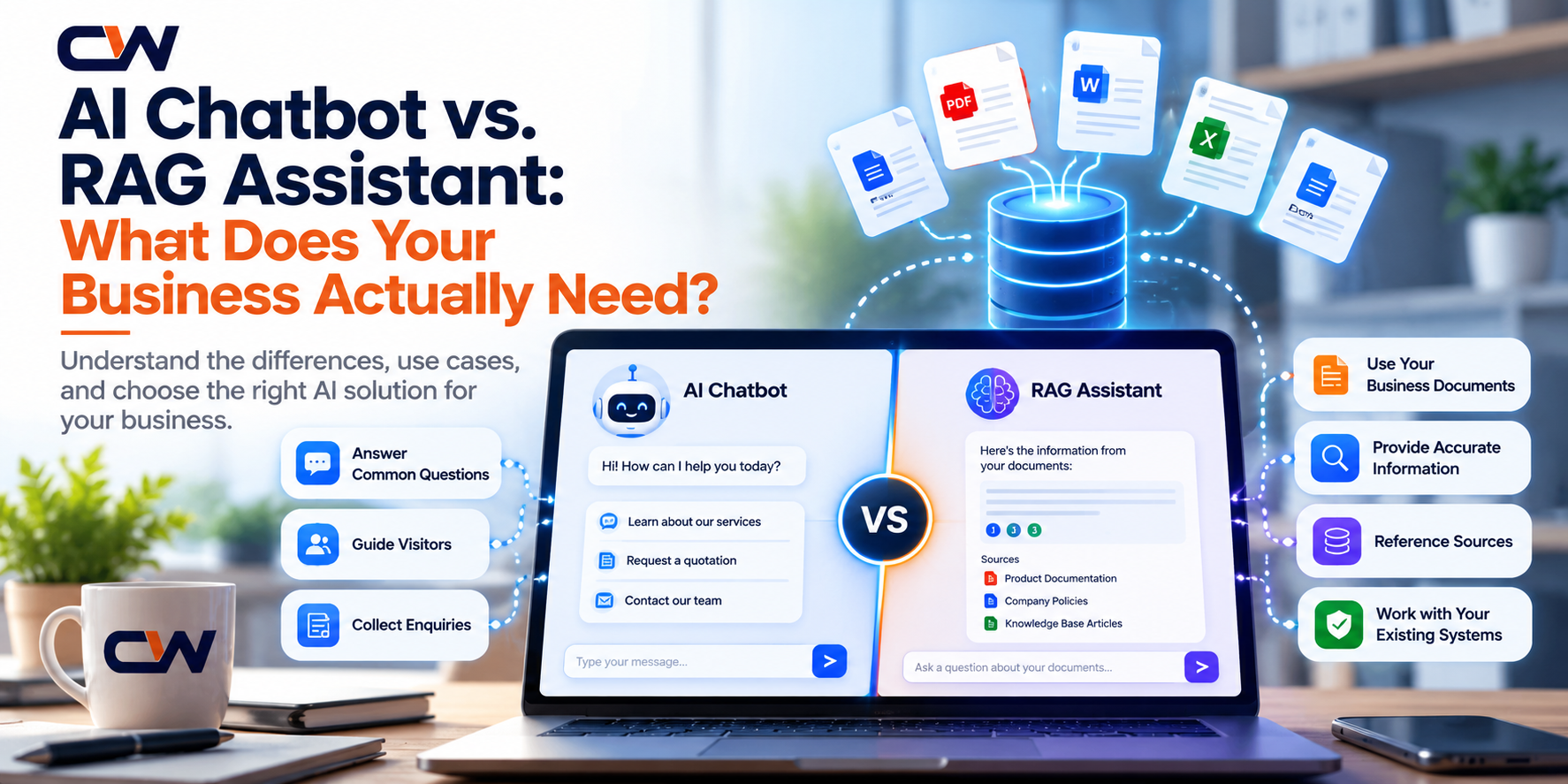
Depending on how it is designed, it can answer common questions, guide visitors through a process, collect enquiry details, help customers navigate services, or connect users to a human support representative.
For example, a website chatbot for a software development company could answer questions such as:
- What services does the company provide?
- How can I request a project estimate?
- What information should I prepare before discussing a project?
- How can I contact the team?
A well-designed chatbot can make it easier for visitors to find information without navigating multiple pages.
However, a general-purpose language model may produce inaccurate answers if it does not have access to reliable information about your business. Adding prompts alone does not guarantee that every answer will be correct.
That is where retrieval-based approaches can help.
What Is a RAG Assistant?
RAG stands for Retrieval-Augmented Generation.
It is an approach that combines information retrieval with a language model. Before generating an answer, the application searches a selected knowledge source for relevant information and uses the retrieved content to formulate a response.
Depending on the implementation, those sources might include:
- Product documentation and user manuals.
- Company policies and internal procedures.
- Frequently asked questions.
- Approved support articles.
- Product catalogues and technical documents.
- Internal knowledge bases.
For example, imagine an employee asks:
"According to our leave policy, how many days of annual leave can a new employee take?"
A RAG assistant can search the approved policy documents, retrieve relevant passages, and generate an answer based on that information.
A production-ready system can also provide source references, indicate when information is unavailable, and direct the user to a human when necessary.
However, RAG is not automatically accurate. Its performance depends on document quality, retrieval relevance, access controls, evaluation, and how the application handles missing or conflicting information.
AI Chatbot vs. RAG Assistant: The Key Differences
The right choice depends on the problem you want to solve.
1. Information sources
A chatbot may use predefined responses, business rules, an LLM, or connected APIs.
A RAG assistant adds a retrieval layer that searches a knowledge collection before generating an answer.
2. Handling business-specific questions
A basic chatbot may work well for common questions with predictable answers.
A RAG assistant is often more suitable when users need answers drawn from a substantial collection of company documents.
3. Updating information
A chatbot using hardcoded answers may require manual changes when information changes.
With a properly maintained RAG pipeline, updated documents can be processed and indexed so the assistant can retrieve the latest approved information. The update process and freshness of the data must still be managed.
4. Complexity and maintenance
A simple FAQ chatbot may be relatively straightforward to implement.
A RAG assistant typically requires additional work involving document ingestion, parsing, chunking, embeddings, retrieval, permissions, evaluation, and monitoring.
The more complex solution is not necessarily the better solution. It should be justified by the actual business requirements.
Five Real Business Use Cases for RAG
1. Customer support
Businesses with extensive product documentation can use a knowledge assistant to help customers find relevant instructions, troubleshooting steps, and policy information.
The assistant should distinguish between supported answers and questions that require a human representative.
2. Internal employee knowledge
Employees often spend time searching shared drives, manuals, HR policies, and internal documentation.
A company knowledge assistant can help them find relevant information faster, provided it respects document permissions and access restrictions.
3. Product discovery
An ecommerce business can explore assistants that retrieve product specifications, compatibility information, and approved product details to help customers make informed decisions.
Product availability, prices, and order status should be retrieved from authoritative live systems when current information is required.
4. Document analysis
Teams working with lengthy reports, technical manuals, proposals, and operational documents can use AI-assisted retrieval to locate relevant passages and prepare summaries.
For important decisions, users should be able to verify the original sources rather than relying blindly on generated text.
5. Sales and service enquiries
An AI assistant can answer questions about approved service information, gather preliminary requirements, and guide prospective customers towards a consultation or enquiry form.
Sensitive pricing, contractual commitments, and customized quotations should follow the business's approved processes.
How Does a RAG Assistant Work?
A typical RAG application follows two main stages.
Stage 1: Prepare the knowledge base
- Collect approved documents and data sources.
- Extract and clean their contents.
- Split long documents into useful sections.
- Generate embeddings and index the content in a suitable search system.
- Maintain document versions, permissions, and update processes.
Stage 2: Answer a user's question
- Receive the user's question.
- Search for relevant content using keyword search, vector search, or a hybrid approach.
- Optionally rerank the retrieved passages for relevance.
- Send the question and selected context to the language model.
- Return an answer with source references where appropriate.
- Record suitable evaluation and operational signals while respecting privacy requirements.
The objective is not simply to generate a fluent answer. It is to retrieve relevant information and provide a response that users can verify.
Does Your Business Need a Chatbot or RAG?
Use these questions to narrow down your requirements.
Choose a simpler chatbot when:
- Your questions are predictable and relatively limited.
- Most answers can be maintained as approved FAQs.
- You need basic enquiry collection or guided navigation.
- A complex document retrieval system would add little value.
Consider a RAG assistant when:
- Your information is spread across many documents.
- Users ask varied questions about company-specific information.
- Answers need to reference approved knowledge sources.
- Your team spends significant time searching documentation.
- You can establish a process for keeping the knowledge base accurate and secure.
Consider a hybrid solution when:
You need conversational assistance, document retrieval, live API integrations, and human handoff in one application.
For example, a customer support assistant might retrieve troubleshooting instructions from a knowledge base while checking order status through an authenticated API.
The architecture should follow the requirements, not the popularity of a particular AI technique.
What Should You Consider Before Building an AI Assistant?
Before starting development, review these six areas.
1. Business objective: Identify the task you want to improve and establish a measurable baseline.
2. Data readiness: Check whether your documents are accurate, current, accessible, and legally appropriate to use.
3. Privacy and security: Define who can access which information, how data is stored, and which external services receive it.
4. Answer quality: Test representative questions, difficult queries, missing information, and situations where the system should refuse to guess.
5. Operating costs: Consider model usage, embeddings, search infrastructure, document processing, monitoring, and ongoing maintenance.
6. Human oversight: Decide when the assistant should escalate a question instead of attempting to answer it.
A successful AI project requires more than connecting a language model to a website. It needs thoughtful product design, reliable data, evaluation, and a clear plan for ongoing operation.
How Much Does an AI Assistant Cost?
There is no single price that applies to every AI chatbot or RAG application.
A basic FAQ assistant has different requirements from an enterprise knowledge platform connected to internal systems and thousands of documents.
The project scope may depend on:
- Number and type of data sources.
- Document volume and processing complexity.
- Search and retrieval requirements.
- User authentication and permissions.
- Integration with existing applications.
- Expected usage and response times.
- Testing, monitoring, and maintenance requirements.
A practical starting point is to build a focused first version around one business problem, test it with real users, and expand only after the results justify further investment.
Request a scoped estimate based on your actual requirements rather than choosing a solution based on a generic price alone.
How CycloneWebz Can Help
At CycloneWebz, we help businesses explore and develop AI-powered applications, custom chatbots, RAG assistants, and software integrations.
Our approach begins by understanding the business problem, evaluating available data, selecting an appropriate architecture, and defining how the solution will be tested.
Depending on the use case, a project may include:
- AI assistant and chatbot development.
- Retrieval-Augmented Generation (RAG).
- Document processing and knowledge retrieval.
- API and application integrations.
- Evaluation, quality assurance, and monitoring.
- Web and mobile application development.
Explore our [AI development services](https://www.cyclonewebz.com/our-services/ai-ml) to learn more about the solutions we build.
If you have an idea for an AI assistant, share the problem you want to solve through our [contact page](https://www.cyclonewebz.com/contact-us).
Final Thoughts
AI chatbots and RAG assistants are not competing answers to every business problem. They are different approaches that can also work together.
A straightforward chatbot may be all you need to handle common questions. A RAG assistant may be more appropriate when people need reliable access to information stored across business documents.
The best solution is the one that fits your users, your data, your security requirements, and your measurable business objectives.
Start with one real problem. Choose the simplest suitable architecture. Test the answers. Improve with evidence.
A question for you
If you could introduce one AI assistant into your business today, what would you want it to do first: answer customer questions, search internal documents, automate enquiries, or help your team make better decisions?
Share your thoughts, and explore [CycloneWebz](https://www.cyclonewebz.com/) for more information about our digital development services.